
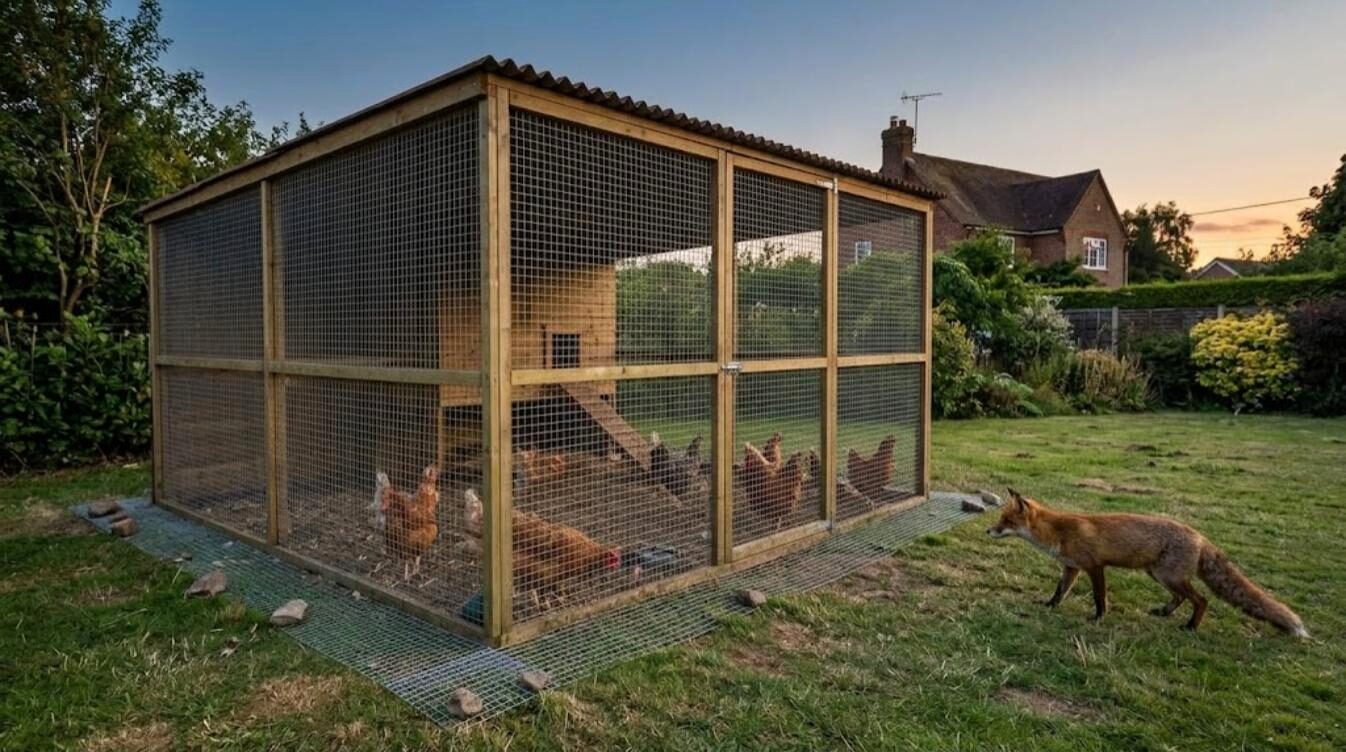
How to Fox-Proof a Chicken Coop and Run: A UK Keeper’s Guide
This guide contains affiliate links. If you buy through them we may earn a small commission, at no extra cost to you. Find out more.
Ask any British hen keeper about their worst day and there’s a good chance a fox is involved. Foxes live in towns and cities as well as the countryside, they’re bold, clever and patient, and they often strike at dusk, at dawn or in broad daylight when they have cubs to feed in spring.
The good news is that a properly secured coop and run will keep your hens safe. Here’s how to fox-proof your set-up, from the quick wins to the bigger jobs.
How foxes get to chickens
Knowing how foxes attack tells you where to focus:
- Through an open door — by far the most common cause of losses. A pop-hole left open at dusk is an open invitation.
- By digging under the run or coop.
- By tearing through thin chicken wire or pushing in weak panels.
- By lifting or nosing open sliding doors and simple catches.
- By climbing or jumping over low fences into an uncovered run.
1. Shut the door every night — automatically
The single most effective thing you can do is make sure the coop is closed every evening, without fail. An automatic door does this for you, even if you’re late home or forget. Choose one with a self-locking or anti-lift door so a fox can’t lever it open.
Our top pick for fox security is the ChickenGuard PRO with Self-Locking Door, which locks itself shut when it closes. For more options, see our guides to the best automatic coop doors and the best solar and Wi-Fi doors.
2. Replace chicken wire with welded mesh
Traditional hexagonal “chicken wire” is designed to keep chickens in, not to keep foxes out. A fox can bite through or tear thin wire surprisingly easily. Galvanised welded mesh is much stronger.
- Use galvanised welded mesh rather than twisted hexagonal wire for the run.
- Smaller holes (around 13mm) also keep out rats and stop foxes reaching through.
- Thicker wire is stronger — check the wire gauge before you buy.
- Fix the mesh securely to the frame with screws and washers or heavy-duty staples, not just a few tacks.
For smaller jobs such as covering gaps, vents and the bottom of a run, a roll like the VOUNOT 13mm galvanised welded mesh is a handy size.
3. Stop foxes digging under the run
Foxes are excellent diggers. There are two common ways to stop them:
- Bury the mesh: dig a trench around the run and sink the mesh 30cm or so into the ground.
- Lay a mesh “apron” or skirt: fix mesh to the bottom of the run and lay it flat on the ground outwards, around 30–60cm wide, pegged down or covered with slabs or turf. When a fox tries to dig at the base, it hits the mesh. This is usually easier than digging a trench.
Strips of hot-dip galvanised mesh, such as JAHOMFAI rodent mesh panels, are useful for making a skirt or lining the floor of a run.
4. Upgrade the locks and catches
Foxes can learn to nudge open simple swivel catches and sliding bolts. On every door and nest box lid:
- Use two-step locks that a fox can’t open with its nose — for example, a bolt plus a carabiner or spring clip through the hole.
- Check that doors close tightly with no gap at the bottom a fox could get a paw under.
- Make sure the nest box lid can’t be lifted from outside.
5. Cover the run
Foxes can climb and jump surprisingly well. A fully covered run — with a solid roof or strong mesh on top — stops them getting in over the top. A solid roof also keeps the run dry and helps if you ever need to keep hens under cover during a bird flu housing order.
6. Consider electric poultry netting for free-ranging
If your hens free-range across a larger area, electric poultry netting is one of the most effective fox deterrents. It gives foxes a short, safe but memorable shock.
A kit such as this 50m electric poultry netting stands 120cm high. You will need a separate energiser and should follow the safety instructions carefully, particularly if you have children or pets.
7. Make your garden less attractive to foxes
- Don’t leave spilled feed or kitchen waste lying around.
- Keep bins secure and compost covered.
- Clear dense undergrowth close to the run where foxes can hide and watch.
- Be extra vigilant in spring and early summer, when foxes are feeding cubs and more likely to hunt in daylight.
A quick fox-proofing checklist
- Coop shut every night (ideally with an automatic, self-locking door)
- Welded mesh rather than chicken wire on the run
- Buried mesh or a mesh apron around the base
- Fox-proof locks on every door and lid
- A covered run
- No gaps bigger than a few centimetres anywhere
Frequently asked questions
Will a fox attack chickens in the daytime?
Yes. Foxes do most of their hunting around dusk and dawn, but they will take hens in broad daylight — especially in spring and early summer, when they have cubs to feed.
Is chicken wire fox-proof?
No. Standard chicken wire keeps hens in but won’t reliably keep a determined fox out. Use galvanised welded mesh instead.
Do fox deterrents like lights and sprays work?
Some keepers find motion-activated lights or sprinklers help a little, but foxes often get used to them. They should never replace a secure coop and run.
Prices and product details were checked on Amazon UK in October 2026 and may have changed since. As an Amazon Associate we earn from qualifying purchases.


