
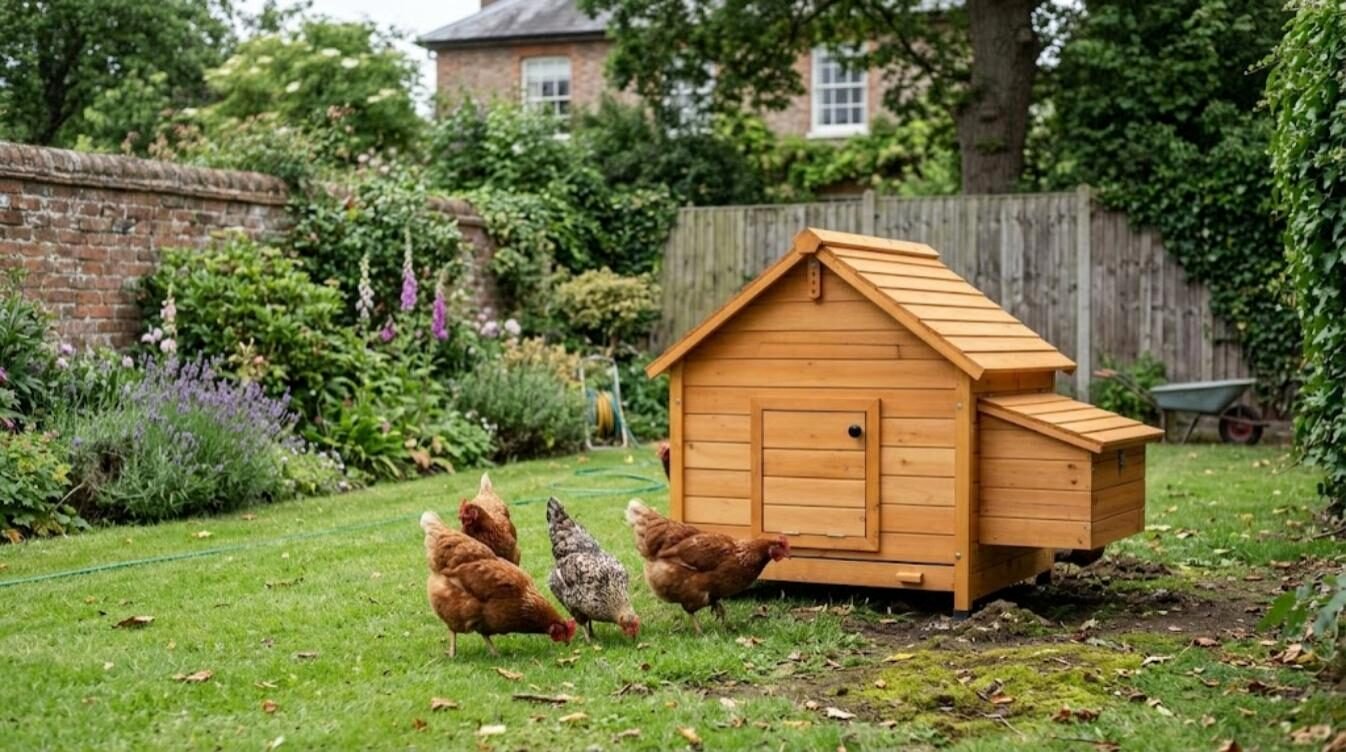
Best Chicken Coops UK (2026): Our Top Picks for Every Garden
This guide contains affiliate links. If you buy through them we may earn a small commission, at no extra cost to you. Find out more.
Choosing a chicken coop is the biggest decision you’ll make when you start keeping hens — and in the UK it comes with a few extra challenges. Our coops have to cope with months of rain, the odd hard frost, a determined urban fox and, if you’re unlucky, a red mite infestation every summer.
We’ve compared the coops that UK keepers actually buy, checking the specs, the materials and hundreds of owner reviews, so you can pick one that suits your garden, your budget and the number of hens you want. Prices are what we found on Amazon UK at the time of writing and do change, so it’s always worth checking.
Our top picks at a glance
| Coop | Best for | Hens* | Price (approx.) |
|---|---|---|---|
| FeelGoodUK Large Coop House | Best value wooden coop | Free-range flocks | £180 |
| Omlet Eglu Cube Large | Best premium plastic coop | Up to 6 large hens | £770 |
| Cocoon 3000WX 8ft | Best coop with built-in run | 3–4 hens | £220 |
| Aivituvin Mobile Coop (XL) | Best for moving around the garden | Small flock | £220 |
| FeelGoodUK Windsor | Best budget plastic-panel coop | Small flock | £145 |
| VOUNOT Small Coop and Run | Best for just two hens | 2 small hens | £96 |
*Capacity as stated by the manufacturer where given. In practice these figures are generous — see “How many hens will it really hold?” below.
The best chicken coops in the UK
1. FeelGoodUK Large Coop House — best value wooden coop
If you plan to let your hens free-range for most of the day and simply need a solid, well-thought-out house to lock them in at night, this is the coop we’d start with. It’s a proper British-designed hen house rather than a flat-pack “ark”, and it has a big following among UK keepers.
- Overall size: roughly 115cm wide x 85cm deep x 90cm high
- Tongue-and-groove wooden panels and roof
- Twin-section external nest box (an extra box can be added)
- Four roosting perches and adjustable ventilation
- Drop-down doors and ramps at the front and back
What we like: The roof is solid tongue-and-groove timber rather than roofing felt. That matters more than it sounds: felt is a favourite hiding place for red mite, so leaving it out makes the coop easier to keep clean. Four perches and a twin nest box give a small flock plenty of room at night.
Worth knowing: It’s a house only, with no attached run, so it suits hens that free-range during the day or go inside a separate walk-in run. As with any wooden coop, give it a coat of animal-safe wood treatment before your hens move in.
2. Omlet Eglu Cube Large — best premium plastic coop
The Eglu Cube is the coop you’ll see in a lot of British gardens, and for good reason. It’s expensive, but it’s built to last and it’s about as low-maintenance as a coop gets.
- Suitable for up to 6 large hens, 8 medium breeds or 10 bantams (manufacturer’s figures)
- Twin-wall insulated plastic panels
- Slide-out trays and wipe-clean surfaces
- Comes in three boxes with how-to-build videos
- Note: the listing we checked is the coop only — the run is sold separately
What we like: Cleaning is genuinely quick: the trays slide out and the whole thing can be hosed down. Plastic gives red mite far fewer places to hide than wood, and the insulated panels help on cold winter nights and hot summer days.
Worth knowing: This is a big investment, and once you add a run the total climbs further. Double-check exactly what’s included before you buy, as Omlet sells the Cube in several bundles.
3. Cocoon 3000WX 8ft — best coop with a built-in run
If you want everything in one unit — house, nest box and run — the Cocoon 3000WX is a popular choice that doesn’t break the bank.
- Approx. 250cm long x 76cm wide x 103cm high, including nest box and roof
- Suitable for 3–4 birds, depending on breed and size
- Metal-lined pull-out tray for cleaning
- Opening roof panels for easy access
- Not a walk-in coop
What we like: The pull-out tray and lift-up roof panels make the weekly clean-out much less of a chore, and the integrated run gives your hens somewhere safe to scratch about when you’re not around.
Worth knowing: At 76cm wide, the run is fairly narrow, so we’d stick to three hens rather than four if they’ll spend long periods shut in. Because you can’t walk into it, reaching the far end of the run takes a bit of stretching.
4. Aivituvin Mobile Coop (XL) — best for moving around the garden
Hens are very good at turning a patch of lawn into bare mud. A coop on wheels lets you move them onto fresh grass every few days, which is kinder to both your hens and your garden.
- Approx. 190cm long x 66cm wide x 100cm high
- Two wheels and a long handle for moving
- Two-section nest box with slide-out metal tray
- Run underneath the house
- Asphalt-style sloping roof
What we like: It’s one of the better-reviewed mobile coops on Amazon UK, and the slide-out tray and spring latches are useful touches at this price.
Worth knowing: Like most coops in this price bracket it’s made from softwood, so it will need regular treatment to cope with British weather. Wheeled coops also need fairly level ground to move easily.
5. FeelGoodUK Windsor — best budget plastic-panel coop
The Windsor sits between a wooden coop and a full plastic one: it has a wooden frame with twin-wall plastic panels, which makes it easier to clean than an all-timber house.
- Approx. 175cm wide x 66cm deep x 100cm high
- Wooden frame with twin-wall plastic panels
- Twin-section nest box with prop-up lid
- Slide-out galvanised tray
- Attached run with sliding door between house and run
What we like: You get many of the cleaning benefits of plastic without paying Omlet prices, and the solid roof again avoids roofing felt.
Worth knowing: Its owner rating is lower than the others on our list, so check recent reviews before ordering. There’s only one internal perch, so it suits a small flock.
6. VOUNOT Small Coop and Run — best for just two hens
If you’re starting very small — a pair of bantams or two small hens — this is one of the cheapest complete coop-and-run sets available, and it has thousands of reviews.
- Space for 2 small or medium chickens, according to the seller
- Approx. 210cm x 85cm x 85cm overall
- Nest box you can open from outside
- Removable tray
- Asphalt roof
What we like: It’s an affordable way to find out whether hen keeping is for you, and the removable tray makes cleaning straightforward.
Worth knowing: Treat this as a starter coop. The timber is lightweight, so we’d add extra security (see below) if foxes visit your garden, and you’ll want something larger if you catch the chicken bug and add to your flock.
How to choose the right chicken coop
How many hens will it really hold?
Manufacturers’ capacities usually describe the maximum number of birds that will physically fit at night, not how many will live in it happily. As a rule of thumb, buy a coop rated for at least one or two more hens than you actually plan to keep. Larger breeds need more room than bantams, and overcrowding leads to squabbling, feather pecking and dirtier bedding.
- Perches: allow roughly 20–30cm of perch space per hen.
- Nest boxes: one nest box per three or four hens is plenty — they’ll often all queue for the same one anyway.
- Run space: if your hens can’t free-range, give them as much run space as your garden allows. A cramped run quickly turns to mud in a British winter.
Wood or plastic?
Wooden coops are cheaper, look more traditional and are easy to adapt, but they need treating every year or so and have more cracks and joints where red mite can hide. Plastic coops cost more up front but are far quicker to clean, don’t rot and make red mite much easier to control. If you have the budget and hate cleaning, plastic usually pays for itself in time saved.
Keeping the fox out
Foxes are the number one cause of losses for UK backyard keepers, including in towns and cities. (For the full rundown, see our guide on how to fox-proof a chicken coop.) Whatever coop you choose:
- Shut your hens in every night, or fit an automatic coop door so you never forget.
- Look for locks and latches a fox can’t nose open — swivel catches on cheaper coops can often be upgraded with carabiners.
- Use strong welded mesh rather than thin chicken wire for runs. Foxes can bite through or tear lightweight wire.
- Dig the mesh into the ground or lay a mesh “skirt” around the run so foxes can’t dig underneath.
Cleaning and red mite
Red mite live in the cracks of a coop by day and feed on your hens at night, and they thrive in warm weather. Coops with a slide-out tray, removable perches and as few hidden joints as possible are far easier to keep on top of. Avoid coops with roofing felt if you can. If you do get mites, follow our step-by-step guide on how to get rid of red mite.
The rules for UK keepers
In Great Britain, you now need to register your birds with the Animal and Plant Health Agency (APHA) even if you only keep a few hens as pets. During bird flu outbreaks, the government may also require poultry to be housed or kept under cover, so it’s worth choosing a set-up where you could cover the run if needed. Always check the latest guidance on GOV.UK — our guide to registering your chickens explains how.
Frequently asked questions
What size coop do I need for 4 hens?
Look for a coop rated for at least five or six hens if you want four to live comfortably, especially if they’ll spend time shut in the run. The Omlet Eglu Cube Large and FeelGoodUK Large Coop House both suit a flock of four well.
Are cheap chicken coops any good?
They can be a good way to start, but most budget coops use thin softwood and basic latches. Expect to treat the wood, upgrade the locks and possibly replace the coop after a few years.
Do I need a run as well as a coop?
Unless your hens can free-range safely all day, yes. A run keeps them safe from foxes when you’re out, and it gives you somewhere to keep them during bird flu housing measures.
Wood or plastic — which lasts longer?
A well-made plastic coop will usually outlast a budget wooden one, because it can’t rot. A good-quality wooden coop that’s treated regularly can still last many years.
Prices, ratings and specifications were checked on Amazon UK in October 2026 and may have changed since. As an Amazon Associate we earn from qualifying purchases.


