Do You Need to Register Your Chickens in the UK? (2026 Rules Explained)
The short answer: yes. If you keep chickens in England, Scotland or Wales — even just two or three hens in the back garden — you are now legally required to register them with the government. It’s free and only takes a few minutes online.
Here’s what changed, who needs to register and how to do it.
What changed in 2024?
Until 2024, registration was only compulsory for people keeping 50 or more birds. After the UK’s worst ever bird flu outbreaks, the governments of England, Scotland and Wales lowered that threshold to just one bird. Since autumn 2024, every keeper of poultry in Great Britain must be registered, including people who keep hens purely as pets.
The aim is to make sure the authorities can contact every bird keeper quickly if bird flu is found nearby, and to lift disease control zones sooner once an outbreak is over.
Who needs to register?
- Anyone keeping chickens, ducks, geese, turkeys, quail or other poultry in Great Britain — even a single bird.
- Keepers of pet hens, rescue hens and ex-battery hens.
- People keeping birds on an allotment.
Pet birds such as budgies, parrots, canaries and finches don’t need to be registered if they are kept entirely indoors with no access to the outside.
If you live in Northern Ireland, the rules are different — check with DAERA.
How to register your chickens
- Go to the GOV.UK page for registering as a keeper of fewer than 50 poultry or other captive birds (England and Wales). Scotland has its own online register via the Scottish Government.
- Fill in your contact details and the address where your birds are kept.
- Add details of your birds: the species, how many you have and why you keep them (for example, as pets or for eggs).
- Submit the form. There’s no charge.
You don’t need a County Parish Holding (CPH) number if you keep fewer than 50 birds.
Keeping your registration up to date
Keepers are now required to review their registration details every year and update them if anything changes — for example, if you move house, or the number or type of birds you keep changes significantly.
What happens if I don’t register?
Not registering is a legal offence. More importantly, if bird flu is confirmed near you, you may not receive the warnings and advice that registered keepers get — putting your hens at greater risk.
Bird flu and housing orders
During outbreaks, the government can bring in an Avian Influenza Prevention Zone (AIPZ). This may require you to follow strict biosecurity rules and, in some cases, keep your birds housed or under cover. Being registered means you’ll hear about these changes promptly.
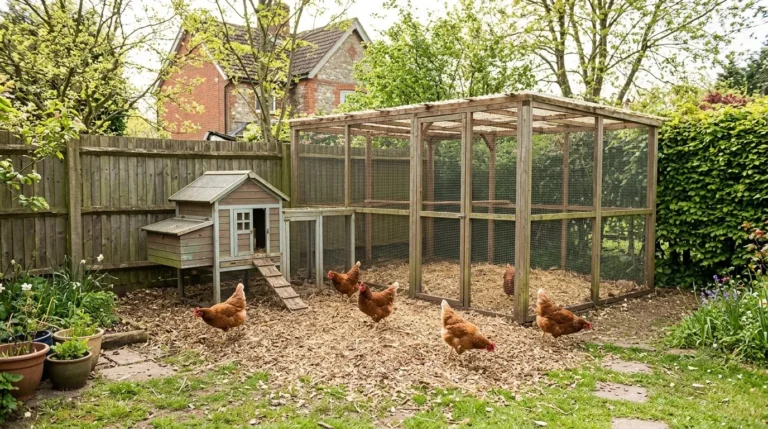
It’s worth planning for this before you need it: a covered run is the easiest way to keep hens indoors without stressing them. Our guide to the best chicken coops in the UK covers coops with built-in runs.
Other rules for keeping chickens in your garden
- Check your deeds or tenancy agreement. There’s no general law against keeping a few hens in your garden, but some properties have covenants or rental terms that forbid it.
- Think about your neighbours. Hens are fairly quiet, but cockerels are not — and noise complaints can be treated as a statutory nuisance.
- Keep things clean. Store feed securely and keep the area tidy to avoid attracting rats.
- Don’t feed kitchen scraps. In the UK it is illegal to feed poultry catering waste or kitchen scraps, to prevent the spread of disease.
Frequently asked questions
Do I need to register just two pet hens?
Yes. The rules apply to every keeper in Great Britain, regardless of how many birds you have.
Does it cost anything to register?
No, registration is free.
Do I need to register if I only keep ducks?
Yes. Ducks, geese, quail and other poultry are all covered.
Frequently asked questions
Do I need to register if I only have two hens?
Yes. Since the rule change in 2024, registration in Great Britain applies to keepers of any number of poultry, including a couple of pet hens in the garden.
Does it cost anything to register?
No. Registration is free.
Do I need to register ducks, geese or quail?
Yes. The requirement covers poultry and other captive birds kept outdoors, not just chickens.
I’m rehoming ex-battery hens. Do I need to register before they arrive?
It’s best to register as soon as you know you’ll be keeping birds, so you’re on the list for bird flu alerts from day one. Rehoming charities often remind adopters to do this.
Will registering mean inspections?
Registration is mainly so the authorities can contact keepers during disease outbreaks. Backyard keepers aren’t routinely inspected simply because they’ve registered.
What else should I do to protect my hens from bird flu?
Keep feed and water under cover, stop wild birds getting into the run, use a footdip with an approved disinfectant and follow any housing measures. Our guides to bird flu and backyard chickens, run covers and poultry disinfectants explain how.
This guide is a summary for UK backyard keepers and was checked in October 2026. Rules can change, so always check the latest guidance on GOV.UK or the Scottish Government website.