How Much Space Do Chickens Need? A Simple UK Guide
Giving hens enough space is one of the most important things you can do for their health and happiness. Cramped hens are more likely to fight, peck each other’s feathers and pick up disease — and a small run turns to mud in no time during a British winter. This guide sets out practical minimum figures for coop, perch, nest box and run space, explains why manufacturers’ capacity figures can be misleading, and shows how to spot the signs of overcrowding.
Quick guide: space per hen
| Area | Large hens | Bantams |
|---|---|---|
| Coop floor | At least 0.3m² each (more is better) | About half that |
| Perch | 20–30cm each | 15–20cm each |
| Nest boxes | 1 per 3–4 hens | 1 per 3–4 hens |
| Run | At least 1m² each — ideally much more | At least 0.5m² each |
These are practical minimums widely used by UK backyard keepers. If your hens can’t free-range, give them as much run space as your garden allows.
Coop space
The coop is where hens sleep, lay and shelter from the worst weather. Floor space matters most on days when hens choose to stay in, and in larger flocks where lower-ranking birds need room to keep out of the way of bossier ones. A rough minimum of 0.3m² of floor per large hen is a reasonable starting point, but if your hens will be shut in for long periods — for example during a bird flu housing order — more space makes a big difference to their behaviour.
Height matters too. Perches should be higher than the nest boxes (hens like to roost as high as they can, and if the nest box is the highest point they may sleep in it and soil it), and there needs to be enough headroom above the perches for good ventilation without draughts blowing directly on roosting birds.
Perch space
At night hens huddle together, so they need less perch length than you might think — around 20–30cm per large hen, a little less for bantams. In hot weather they spread out, so a bit of extra length is useful. Perches should be wide enough for hens to cover their feet with their bodies (around 4–5cm wide with rounded edges works well) and spaced so birds on one perch aren’t sitting directly beneath another.
Nest boxes
Hens happily share nest boxes, and you’ll often find them queuing for one favourite box while others sit empty. One box for every three or four hens is plenty. Each box should be roughly 30cm square for large hens, darker than the rest of the coop and lined with clean bedding. Our guide to the best chicken nest boxes covers the options if your coop doesn’t have enough.
Why manufacturers’ figures can mislead
A coop advertised as suitable for “six hens” often means six hens can physically squeeze onto the perches at night. It rarely accounts for daytime space, larger breeds, or days when hens can’t go out. As a rule of thumb, buy a coop rated for one or two more hens than you plan to keep — and if you keep large breeds such as Orpingtons or Brahmas, allow even more. Compare suitable options in our guide to the best coops for 4–6 hens.
Run space matters more than you think
Hens spend almost all their waking hours outside, scratching, dust bathing and foraging. A minimum of around 1m² per large hen is often quoted, but that is a bare minimum — hens kept at that density will strip a grass run to bare earth within weeks. Two to three times that figure gives a much happier flock.
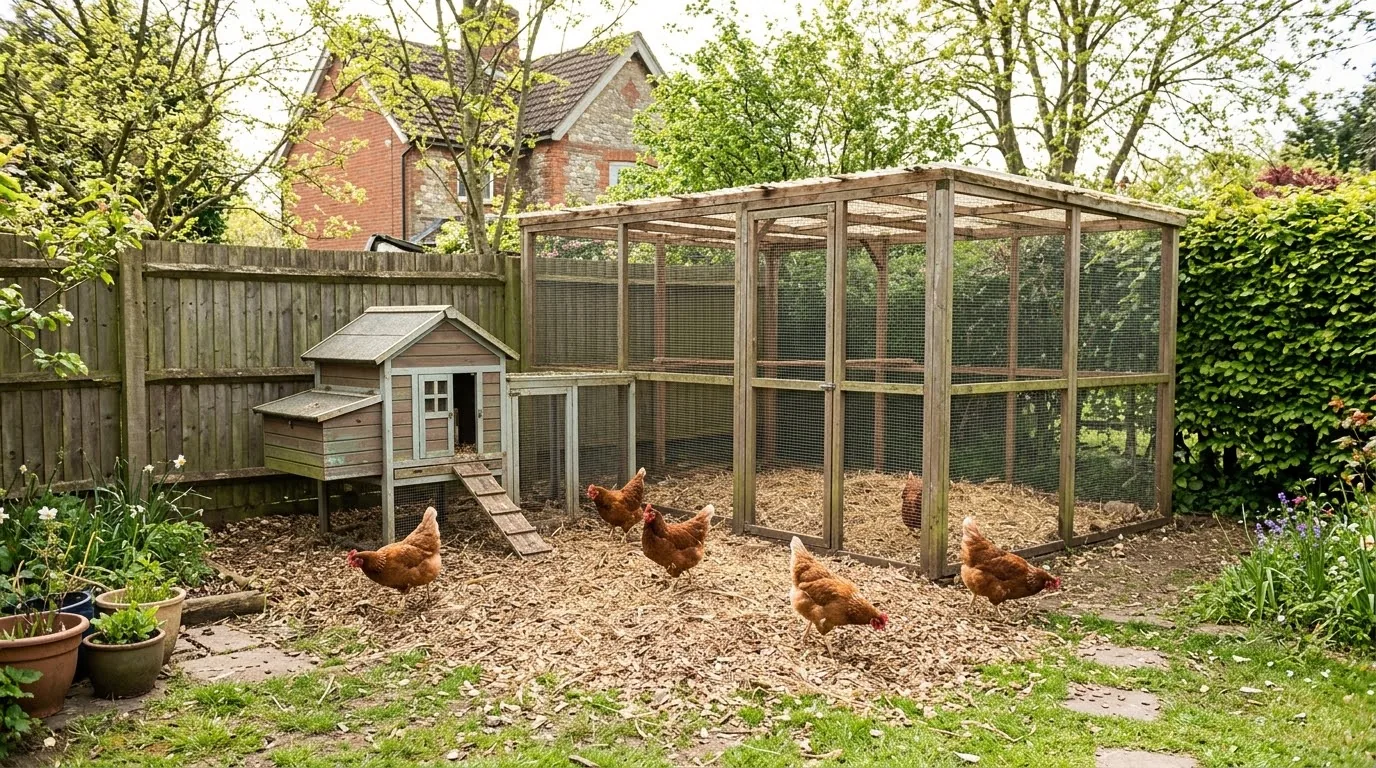
In a typical UK garden, the most practical solution is often a covered run with a deep layer of wood chip on the floor. It stays usable through wet winters, keeps feed and water dry, and keeps wild birds away during bird flu housing measures. See our best walk-in chicken runs and run covers.
Free-ranging: the best way to give hens space
If you can let your hens out into the garden for part of the day, you instantly solve most space problems. Even an hour or two of supervised free-ranging in the afternoon gives hens fresh ground to explore and reduces boredom. The trade-off is that hens will dig up lawns and borders and eat your plants — see our guide to keeping chickens and a garden — and you’ll need to protect them from foxes, which in the UK are active during the day as well as at night.
Signs your hens are overcrowded
- Feather pecking, bullying or a hen that’s constantly chased away from food
- Hens sleeping outside the coop or piled on top of each other
- A run that’s permanently muddy and smelly
- Fewer eggs than expected for the time of year
- Persistent problems with red mite or illness
- Hens laying on the floor because nest boxes are always occupied
If you spot several of these, the fix is usually more run space, more enrichment (perches, a dust bath, hanging greens) or fewer hens.
How many hens can I keep in my garden?
For a typical British back garden, three to six hens is a sensible number. Most keepers start with three — hens are flock animals and shouldn’t be kept alone, and three means one loss doesn’t leave a single bird on her own. Remember that you will also need space for the coop, a run, and somewhere dry to store feed and bedding, and that the coop shouldn’t be right up against a neighbour’s fence.
Before you buy, check your property deeds, tenancy agreement or any local covenants, as some restrict keeping poultry. In England and Wales you’ll also need to register your hens with APHA, however few you keep.
Space for bantams and large breeds
Bantams need roughly half the space of standard hens, which makes them popular for small gardens — though they can fly surprisingly well, so a covered run is a good idea. At the other end of the scale, heavy breeds such as Brahmas, Cochins and Orpingtons need wider pop-holes, sturdier perches set lower down, and noticeably more floor space than the figures above.
Frequently asked questions
How big a run do I need for three chickens?
An absolute minimum would be about 3m², but around 6–9m² gives three hens a far better life, especially if they can’t free-range.
Can I keep chickens in a small garden?
Yes. Three hens in a well-designed coop and covered run can live happily in a modest garden. Bantams are a good option where space is very tight.
Is it OK to keep just two chickens?
It works, but if one dies the other will be alone. Most keepers start with three.
Ready to choose a coop? See our guide to the best chicken coops in the UK.